


Why conflict resolution only works when professionals practise realistic AI conversations


Conflicts are an inevitable part of teamwork. Wherever people work together, differences in style, pace, expectations and communication are bound to arise. Sometimes this leads to friction, sometimes to escalation. And everyone knows that a conflict which isn’t addressed in good time rarely gets any smaller. Yet many employees and managers find it difficult to broach the subject. Not because they don’t know what to say, but because the moment itself creates tension.
That is precisely why conflict management only really works when you can practise in situations that resemble your day-to-day reality.
Conflicts demand how you act in the moment, not what you once heard in a training session.
Conflict management training courses often provide tools: active listening, assertiveness (also known as setting boundaries), exploring interests, de-escalation. But in a real conversation, emotions, underlying frustrations and personalities play a greater role than any model or theory. You hear something in the other person’s voice. The tension rises. Your own reaction changes. You feel a choice: do I say this now, or do I clam up?
You can’t learn that from a book. You develop it by doing it.
Why traditional conflict management often falls short
Many organisations offer workshops and training courses, but professionals recognise that:
– colleagues do not evoke the same emotion or resistance as real situations–
difficult conversations are not accurately simulated–
there are too few scenarios to practise–
you only really learn when the conversation gets tense
As a result, the most difficult part of conflict management often remains unpractised: the moment when someone feels hurt or reacts defensively, withdraws, gets angry or shuts down.
How AI makes conflict management realistic and personal
AI changes this fundamentally. In an AI training scenario, the AI avatar responds to your tone, behaviour, choice of words and empathy. You conduct the conversation as if it were real: the resistance, the emotion and the nuance in phrasing. This creates a safe yet realistic training environment where you can practise difficult conversations without any consequences. It’s OK to make mistakes. Reflect and improve.
Professionals can practise with:
• escalations within teams•
clashing personalities•
misunderstandings that escalate•
disagreements over
responsibilities• situations where someone reacts
defensively or emotionally• criticism perceived as an
attack• conversations with colleagues who fail to honour agreements
AI makes conflict management not only more realistic, but also repeatable. You can try a conversation again with a different approach until it feels right.
Conflicts are situational, so the training must be too
No two conflicts are the same. What works in one conversation won’t work in another. That’s why a single generic model never works for everyone. Professionals need scenarios that suit their team, culture and challenges.
With AI, you can build any scenario.
A team member who is bottling up frustration?
Two colleagues who aren’t working together?
An employee who reacts in a passive-aggressive way?
A conflict between departments?
A difference of opinion that has escalated into a personal conflict?
It can all be practised and trained.
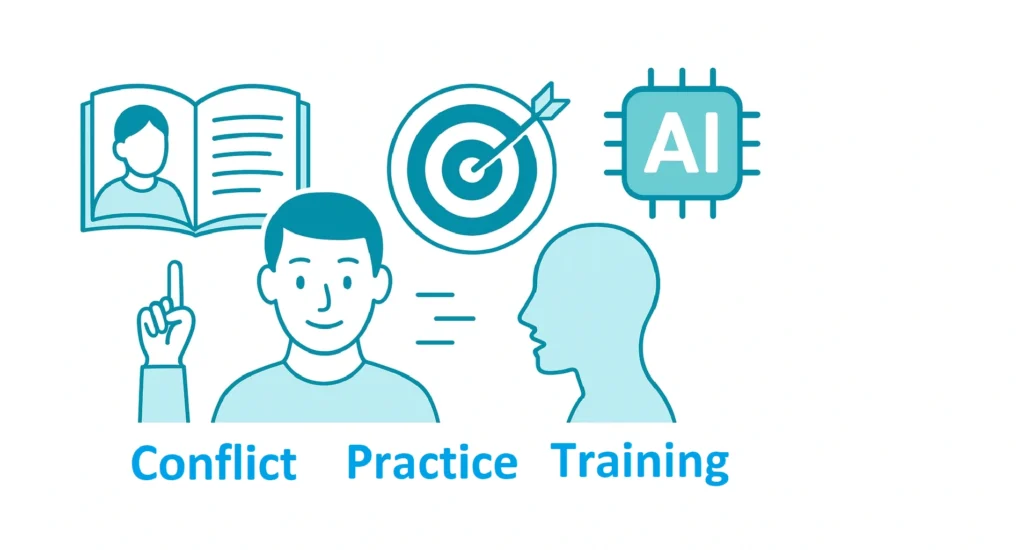
PractAIce: practising conflicts as you experience them in real life
This is where PractAIce makes a big difference. Using the scenario builder, organisations create their own conflict scenarios, fully tailored to team dynamics and culture. The AI avatar can be set to:
• emotional
level• resistance•
communication
style• pace•
typical reactions•
degree of escalation
As a result, a practice conversation no longer feels like training, but like something you’ll face in real life tomorrow.
In the dashboard, employees can see their progress: how they react to tension, how clear they are, how much empathy they show, and how effectively they steer the conversation towards a solution.
Why AI conflict management does lead to behavioural change
AI combines precisely the factors needed for genuine behavioural change:
1. Realism
You experience the real tension of a conflict.
2. Repetition
You can try different approaches and refine the conversation.
3. Immediate feedback
You see straight away what escalates and what de-escalation achieves.
4. Personal relevance
You practise situations from your own professional experience.
This makes conflict management not only learnable, but also sustainable.
Conclusion: you resolve conflicts by having the conversation and practising
Every organisation wants teams that deal with differences honestly, professionally and constructively. But that doesn’t happen by itself. It happens through conversations. Conversations that are tense. Conversations you’d rather put off. Conversations that only go well once you’ve practised them.
AI finally makes this kind of practice possible. And with PractAIce, it becomes personalised, secure and immediately applicable.
Would you like to explore what AI-supported practice can do for conflict management in your organisation? Book a free demo. We’ll show you how to build bespoke scenarios and how teams can noticeably improve their communication skills.