



Giving and receiving feedback: why practice makes a difference


Everyone knows that feedback is important. It helps teams grow, makes collaboration more effective and prevents minor irritations from escalating into major problems. Yet many people find giving and receiving feedback difficult. Conversations get stuck, people become defensive, and the message doesn’t always come across clearly.
Many training courses promise improvement, but in practice it turns out that feedback behaviour is hard to change. That’s because insight alone isn’t enough. Behavioural change requires practice, and that’s exactly where digital role-playing games make the difference.
The paradox of feedback
Giving and receiving feedback feels uncomfortable for most people. We want to learn and grow, but at the same time we avoid the tension that comes with it. When we receive feedback, we often go on the defensive. And when we have to give feedback, we are afraid of hurting someone.
That tension is human, but it means that feedback rarely achieves its goal. In many organisations, it remains a matter of good intentions: we know we need to communicate openly, but we do it too little.
What makes feedback effective?
Good feedback isn’t about being right, but about growth. About improving together. Three things are essential for this:
- Trust and safety. Without psychological safety, no one dares to be vulnerable.
- Clear communication. Feedback only works if the message is specific and respectful.
- Practice and repetition. You don’t learn to give and receive feedback in a single training session, but by doing it.
Just like the ‘golden rules’ from the article ‘20 golden rules for giving and receiving feedback’, which provides guidelines such as describing behaviour specifically, using ‘I’ messages and separating feedback from personality.
It is only through practice that insight becomes meaningful. A conversation in which you really listen, choose your words carefully and learn how to respond to emotions. That is where behaviour changes.
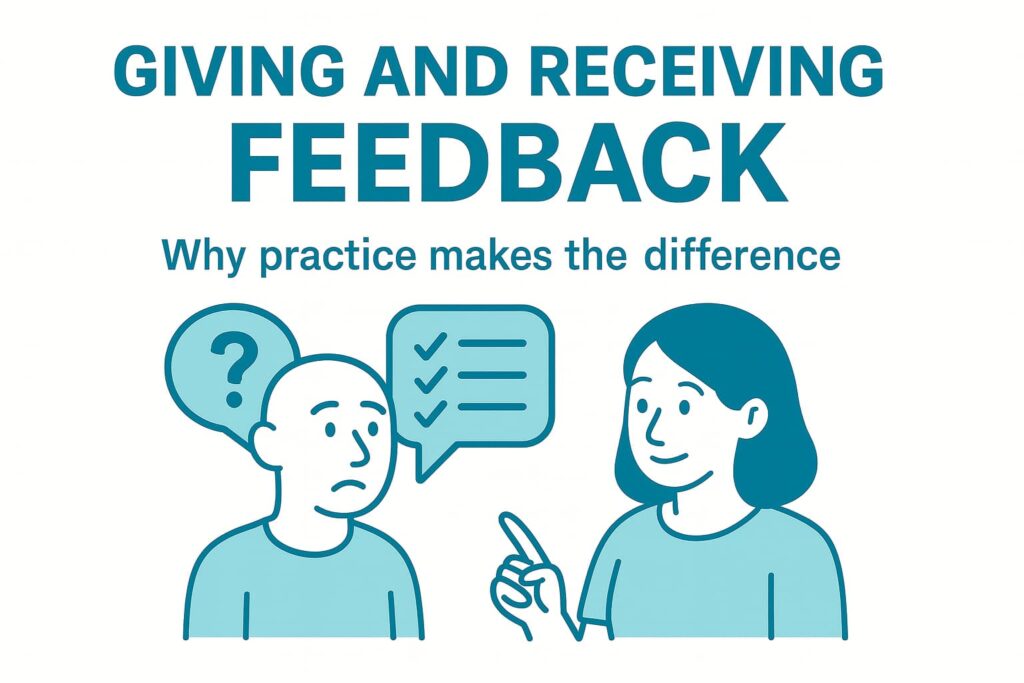
Role-playing: from theory to practice
Role-plays have been part of communication training for decades. They work because they provide a safe space to try out new behaviour. Yet many people find them nerve-wracking. Colleagues are watching, there is time pressure, and the situations sometimes feel too contrived.
Digital role-playing games offer a new way to practise. Instead of a one-off exercise during a training day, you can practise with realistic scenarios whenever you like. An AI avatar responds realistically to what you say and do. This allows you to practise giving and receiving feedback in a safe environment, at your own pace.
Benefits of digital role-playing:
- Recognisable situations. From a difficult appraisal meeting to a colleague who is resistant.
- Immediate feedback. The AI coach analyses your choice of words, tone and empathy.
- Repetition without pressure. You can practise until it feels right.
- Measuring progress. You can see how your communication style improves over time.
By practising regularly, feedback changes from something nerve-wracking into something normal. And that is precisely what behavioural change is all about.
How technology helps with behavioural change
The success of feedback training doesn’t depend on the theory, but on what happens afterwards. Most people fall back into old patterns as soon as the pressure mounts. Technology helps to prevent that.
Digital role-plays make practising accessible and continuous. They bring learning closer to real-life situations: short weekly practice sessions are often more effective than a single intensive training day. Through repetition and reflection, new behaviour emerges that becomes second nature.
Giving and receiving feedback as part of the culture
In organisations with a strong feedback culture, feedback is not a tense moment, but a normal conversation. People engage with one another out of respect and curiosity. That requires time, leadership and practice.
With digital role-plays, employees can develop this behaviour without judgement or risk. A team leader can practise giving constructive feedback, whilst an employee practises receiving it. Both sides of the conversation are thus given attention; something that is often lacking in practice.
Giving and receiving feedback is not a skill you can learn in a single day. It is a muscle that grows stronger with use.
How can you incorporate digital role-playing into your organisation?
- Choose familiar situations. Start with a single specific theme: performance reviews, collaboration or customer feedback. You can use scenarios from existing training programmes, but you can also create your own, tailored to your own workplace.
- Link it to learning objectives. Let employees choose what they want to improve; ownership boosts motivation.
- Use short practice sessions. Just a few minutes a week can make a difference.
- Measure progress and share insights. Make progress visible and discuss what works.
In this way, giving and receiving feedback becomes part of daily work rather than something that only happens during a training session.
Frequently asked questions
What is a digital role-play for feedback?
A digital role-play is an interactive exercise in which you have conversations with an AI avatar. The avatar reacts to your behaviour and provides immediate feedback, allowing you to learn and improve in a safe environment.
How does practising with AI help with giving and receiving feedback?
Through repetition and realistic situations, you develop not only knowledge but, above all, behaviour. You learn to listen, respond and communicate without judgement.
Is digital practice suitable for soft skills?
Precisely so. Communication, leadership and feedback require awareness and repetition, and that is exactly what digital role-playing makes possible.
The next step
Ready to experience how digital role-playing can permanently improve feedback conversations?
With PractAIce, professionals practise realistic conversations with AI avatars. They receive personalised feedback, build confidence and develop lasting new behaviours.
Feel free to request a demo and discover how digital practice in giving and receiving feedback becomes a natural part of learning in practice.