



How do you give good feedback? Practise with an AI avatar


Giving feedback is something we all do, but few people do it properly. It’s quite tricky. If you’re too direct, the other person shuts down. If you’re too cautious, it dilutes the core message and doesn’t come across effectively.
It’s no surprise that people search for “how to give feedback”, “rules of feedback” and “effective feedback”thousands of times every month.
People want to know how to give feedback that doesn’t cause friction, but actually builds bridges. They want to help the other person, but not damage the relationship.
Perhaps you recognise this: you want to raise an issue, but don’t know how.
Or you gave feedback and realised it came across differently than intended.
It sounds simple, yet it’s difficult in practice.
What does good feedback actually mean?
Good feedback helps someone move forward. It’s not about being right, but about growth.
Effective feedback is:
- Specific (you describe concrete behaviour);
- Timely (as soon as possible after the event);
- A balance between positive and constructive;
- Forward-looking (“what could you do differently next time?”).
Yet we all know that knowing the rules doesn’t mean you can apply them.
The real challenge lies in how you say it: the tone, the timing, the intention. And your non-verbal communication.
Why giving feedback often goes wrong
There’s a reason why “how to give feedback without conflict” is such a popular search term.
We quickly fall back on automatic behavioural patterns, such as immediately going on the defensive, making excuses or carefully downplaying things.
Giving feedback is nerve-wracking, for both the giver and the receiver.
You only get one chance to get it right, and you don’t want to damage the relationship.
That is precisely why practice is so important.
By practising, you learn to deal with your own pitfalls, recognise patterns in your reactions, and discover where you can grow.
You learn to manage emotion, tension, and the impact of your words.
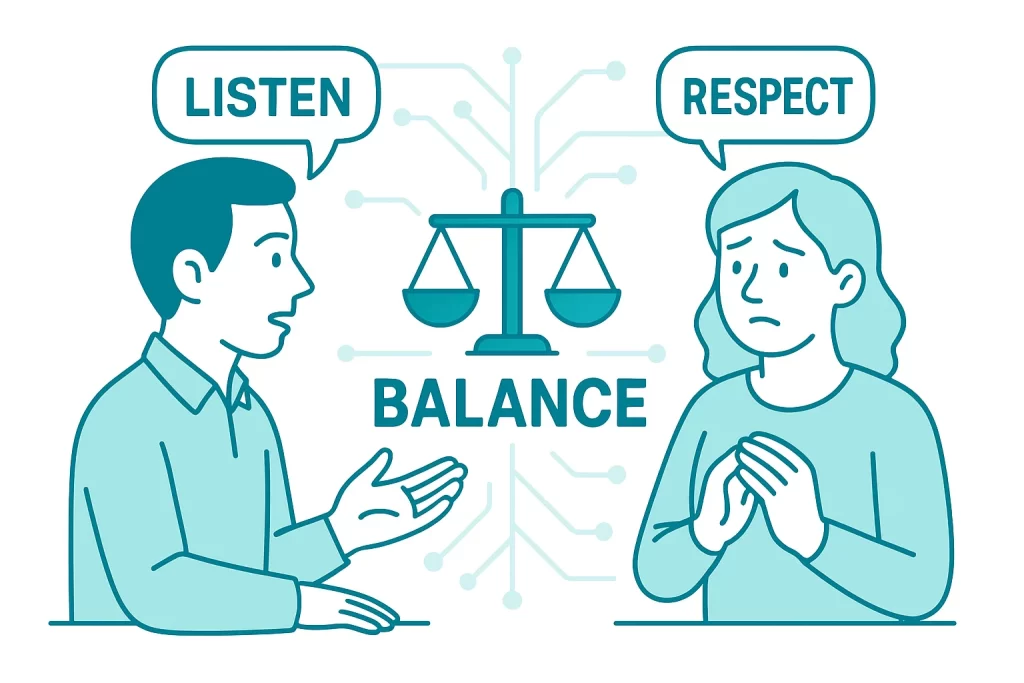
Practising feedback with AI avatars
Traditional training courses help, but are often theoretical or take place in small groups.
With our AI avatars, you can practise feedback situations realistically, whenever you want.
The avatar reacts in a human way – showing surprise, anger or openness, depending on your tone and words.
Afterwards, you can literally see:
- What you said,
- What the effect was,
- And how it could have been better (including specific suggestions).
That’s how feedback becomes concrete. You see your own communication style reflected, without anyone feeling judged.
Who is this for?
HR managers, team leaders and professionals use PractAIce to learn how to give feedback more effectively.
They practise appraisal interviews, peer reviews and their collaboration.
Managers also train in giving feedback that is not directive, but coaching and supportive.
And all without any risks: AI avatars don’t take anything personally, but reflect your behaviour honestly and consistently.
Frequently asked questions about giving feedback
What are the 5 rules of feedback?
Specific, observable, timely, constructive and future-oriented.
How do you give feedback in a respectful way?
Use ‘I’ language (“I noticed that…”), focus on behaviour, not on the person.
How do you practise giving feedback?
Create your own scenario based on something you find difficult, or choose an existing one and practise it with an AI Avatar. Do the role-play, repeat, reflect and improve.
In conclusion
Good feedback isn’t a talent, but a skill. And any skill can be practised.
With AI avatars, you can practise conversations you’d normally avoid.
That way, “how to give feedback” stops being a question you search for, and becomes a skill you’ve mastered.
Curious to see how this can help your team?
Feel free to request a demo via www.practaice.nl