Soft skills are the driving force behind leadership. Those who listen carefully, communicate clearly and give feedback respectfully build trust and achieve results. The great thing is: you can practise this step by step, even without involving other people!
In this blog, we’ll show you exactly what the soft skill of ‘leadership’ is, why it makes such a big difference in day-to-day practice, and how you can get started today. With the help of AI.
What do we mean by the soft skill of leadership?
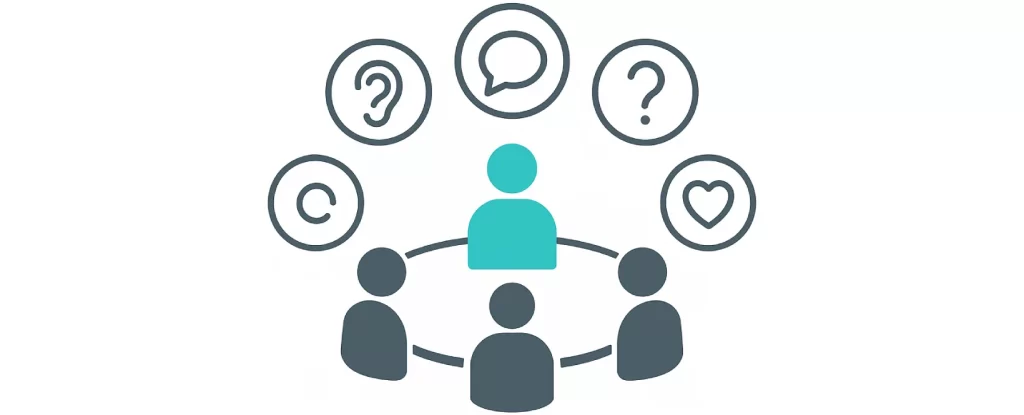
Soft skills are behaviours you see in conversations: listening, explaining clearly, asking questions, dealing with emotions or resistance, and making decisions together. Leadership emerges when you consciously apply those skills, especially when things get challenging.
Key takeaway:
Soft skills leadership is observable behaviour that builds trust, speeds up decision-making processes and improves performance, especially when the going gets tough.
Why do soft skills make such a difference?
Strong leadership is less about the smartest solution and more about how you arrive at it together. If you listen actively, you process information better. If you make expectations clear, people have less to guess at.
And if you consistently follow through on agreements, a sense of ownership naturally develops. This creates an open atmosphere, problems are brought to light sooner, and your team feels empowered to take the initiative. That saves time, hassle and misunderstandings.
How to train specifically in soft skills (with AI)
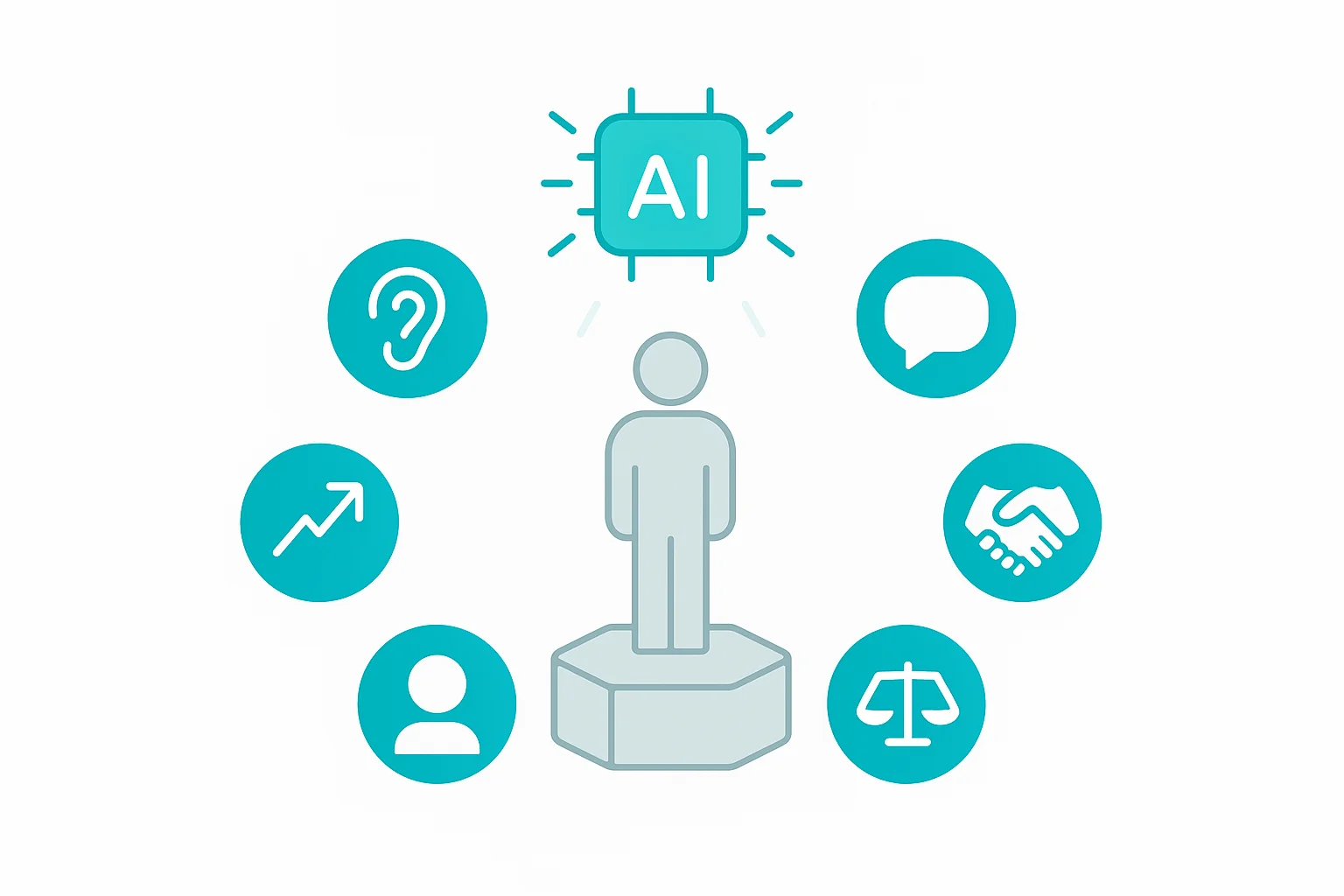
Leadership is about visible behaviour in difficult moments. Listening when things get rough, providing clarity without being harsh, and giving feedback that prompts action. With AI role-plays, you can practise this in a targeted and safe way. Focus in particular on:
1) Self-awareness: taking a moment to pause before speaking
2) Clear communication: brief, friendly and specific
3) Coaching guidance: providing direction without micromanaging
This is how you keep soft skills development motivating
What we often see is that good intentions get bogged down in the hustle and bustle. ‘A one-off training session, then back to business as usual’. But real growth comes from consistent learning. So make it small and achievable: choose one skill per week, link it to one recognisable scenario and plan two short practice sessions of 10–15 minutes. That way, learning doesn’t become an extra chore, but a natural part of your working week.
Developing soft skills through AI
Role-playing, practising scenarios and engaging in conversation. You might think that requires other people. These days, things are different. With AI, you can practise safely, at your own pace and without limits. Afterwards, you receive immediate, specific feedback with examples, and simple dashboards show your progress for each skill, such as listening, persuading or dealing with resistance. By practising briefly but regularly, you’ll soon notice the difference in real-life conversations.
PractAIce is committed to leadership development
PractAIce is committed to providing a learning experience that is accessible and effective. We help you turn familiar situations into practical practice scenarios, set clear learning objectives together, and provide immediate, clear feedback after every conversation. This allows you to experiment safely, grow at your own pace, and see at a glance where you’re making progress.
Curious to see how this works for your team? Schedule a short demo or ask our team any questions you may have. We’d be happy to help you get started.
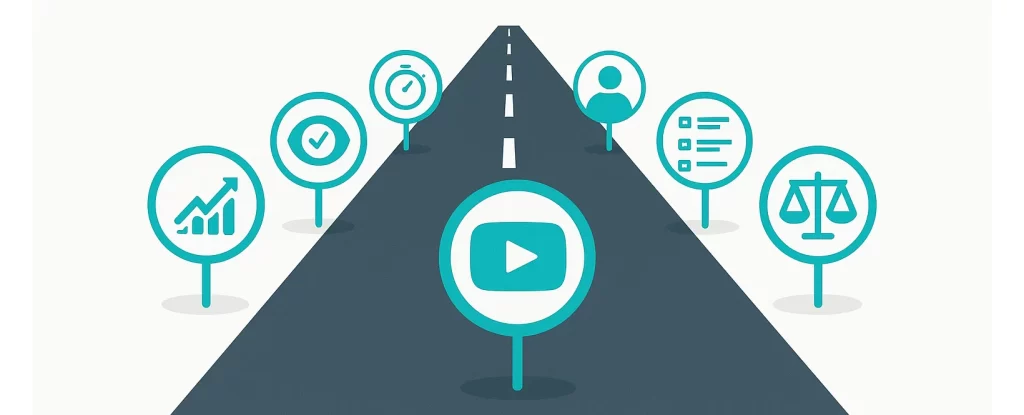
Sales KPIs are the indicators of your commercial health. They show whether you’re heading in the right direction, how effectively you identify opportunities, how often you convert them, and how sustainably you build those relationships. Think of conversion rates, win rates, average revenue per deal, the length of your sales cycle, and so on.
Thanks to AI training, it is now possible to better focus on the quality of sales conversations, as well as achieving higher efficiency and conversion rates. By practising in realistic interactive scenarios, salespeople improve their conversation structure, pace and persuasiveness. This leads to deals being closed more quickly. In this blog, we’ll tell you more about it.
What are sales KPIs?
KPI stands for Key Performance Indicator. It is a clear metric that shows whether your sales approach, lead strategy or customer process is working as intended. A good KPI is specific, measurable and actionable. You can always track, assess and adjust its status. This makes sales KPIs tangible and provides clarity for the salespeople involved.
Think of KPIs as the dashboard lights of your sales department. They show at a glance where things are going well and where you need to make adjustments.
Why sales KPIs?
KPIs provide direction and motivate targeted action. They make progress visible, keep the focus on what works and help with prioritisation. With KPIs, you can:
Assess employee performance more effectively
Set clear goals for each role and funnel stage
Make timely adjustments where things are at risk of stalling
Motivate using evidence
Compare salespeople more fairly
Aligning feedback more effectively with the role
The 12 most commonly used sales KPIs
In the world of sales, there are many types of KPIs. The 12 listed below are the ones we come across most often:
Number of outreach activities (calls, emails, DMs)
Response rate
Show/no-show rate
Quality of discovery
Length of the sales cycle
Conversion rate per stage
Win rate
Average deal size
Pipeline coverage
Forecast reliability
Retention / churn
Upsell / NRR
Why AI training supports KPIs
AI-driven training makes practising accessible, safe and measurable. After all, AI can be tailored to specific KPIs, whilst during practice you are not subject to time pressure, client schedules or the social anxiety of ‘being watched’.
You train without commercial risk, with objective feedback that helps you better align your sales skills with your KPIs and context. This way, you practise precisely those moments that improve your show rate, conversion rate and win rate.
How to get the most out of AI training
To better align your AI training with your KPIs, start small and focused. Choose 2–3 priority KPIs, translate them into specific behaviours, and build short, realistic scenarios around them. Then the practice can begin. Because you’re not practising with people, it reduces social pressure and makes making mistakes much less nerve-wracking. You feel confident to experiment, receive immediate, objective feedback, and can repeat sessions briefly and as often as you like (10–15 mins).
Want to know more about AI sales training?
At PractAIce, we apply AI to soft skills training and competency-based training. We make training practical, accessible and measurable. This allows you to practise with realistic conversations, receive immediate feedback and track your progress. Curious to see how this can boost your show rate, conversion rate and win rate? Book a short demo or give us a call to discuss your needs. We’d be happy to help you get started.
Good customer service isn’t a job title. It’s a skill. And once you’ve mastered it, you’ll benefit from it in any role.
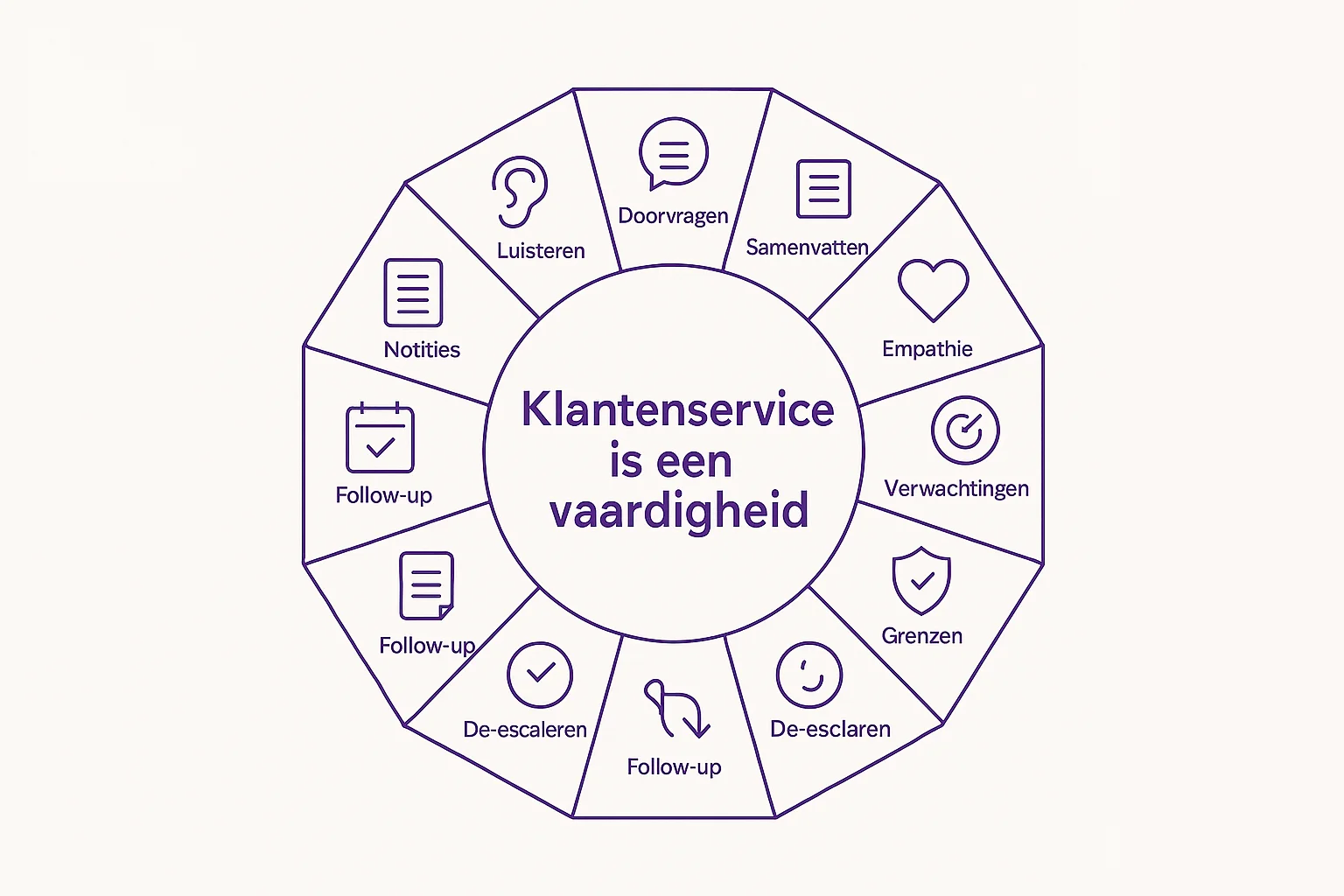
At PractAIce, we train people to have better conversations. Not with scripted scenarios or practice sessions that feel unrealistic, but with realistic role-plays where you see yourself reflected. And what do we see time and time again? Successful people master a number of fundamental skills that go beyond simply ‘staying friendly’.
In this blog, I’m sharing 10 of those skills. Not just to tick off a list, but to get you thinking: where do you stand? What are you already doing well? And where can you still grow?
1. Listening without waiting for your turn to speak
Many people think they listen well, but are actually mostly preoccupied with what they want to say themselves. Genuine attention comes through in your voice. In your timing. In the questions you ask. And you can feel that attention. So can clients.
2. Empathising without getting caught up in the emotion
Empathy doesn’t mean you have to take everything on or solve everything. It means: acknowledging what’s there. Taking what someone says seriously. Even if you can’t fix it straight away. That often takes half the tension out of the situation.
3. Be clear without being blunt
You don’t have to beat around the bush on every tricky point. Clients appreciate clarity, as long as it’s respectful. How you say something is often more important than what you say.
In our soft skills training, for example, people practise setting boundaries without coming across as aloof. It’s a skill in its own right, but one that can be learned.
4. Be patient when you’re in a hurry
It is precisely when your diary is full or the pressure mounts that you want to switch gears quickly. But customers sense that. If you’re just going through the motions, the interaction becomes distant and flat. Sometimes, slowing down is actually the quickest route to a good conversation and a satisfied customer.
5. Dealing with unreasonableness without becoming unreasonable yourself
Sometimes you’ll be dealing with someone who takes their frustration out on you. Not because you’ve done anything wrong, but simply because you happen to be the one who answered the phone. Can you stay calm in that situation? Avoid taking it personally and handle it with care? That way, you’ll prevent things from escalating and remain professional.
6. Stay flexible, even if you already know the answer
Every customer deserves an approach that suits them. Scripts help, but they don’t always reflect reality. The trick is to leave room for nuance. Even if you think you already know what the outcome will be.
You often see this in our competency-based training: people know what needs to be done, but are looking for ways to conduct the conversation professionally and effectively when things get tense, resistance arises or the customer expects something different from what was planned.
7. Dare to summarise, even if you think it’s unnecessary
A lot of frustration arises not because you’re doing nothing, but because people don’t realise you’re working on it. By summarising from time to time (“So, if I understand correctly…”) and actively involving the client, you provide reassurance. And because you come across as knowledgeable, you dispel doubts before they build up.
8. Use your voice and tone as a tool
Words are only part of what you communicate. Your tone, pace and intonation say just as much. In a face-to-face conversation, you have facial expressions and body language. In a phone call, you only have your voice. So it has to be right.
9. Receiving criticism without getting defensive
Not everything you hear is pleasant. Sometimes you receive feedback that doesn’t feel fair. Or that hits hard. But it is precisely this feedback that often contains valuable information you can use. Especially if you don’t immediately put up a defence.
10. Self-reflection
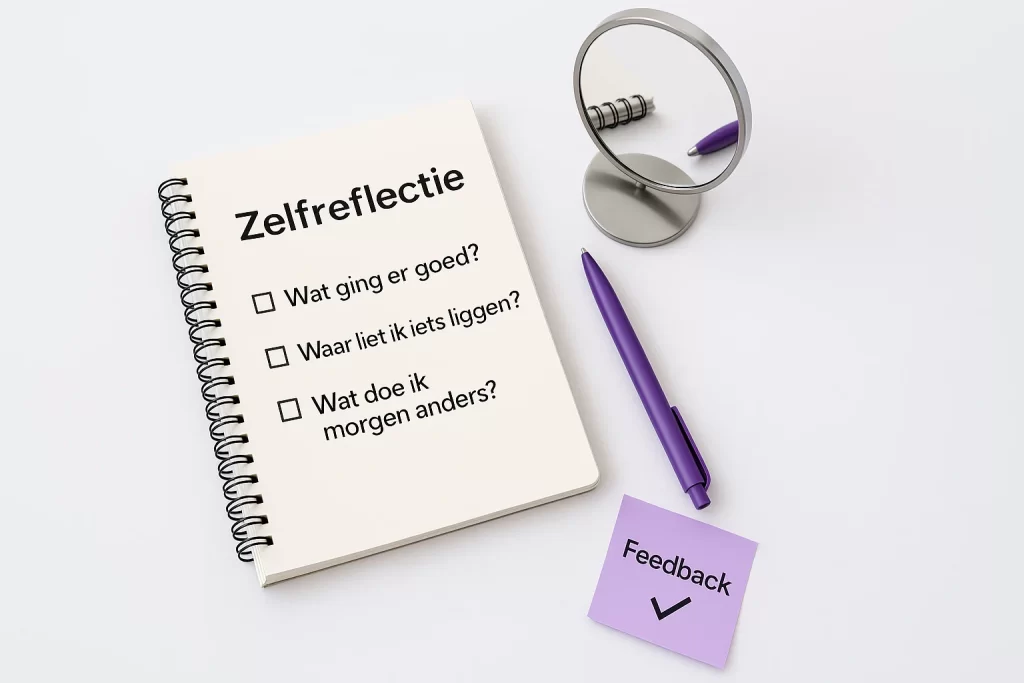
Perhaps the most important skill of all. Daring to look at yourself. Not out of guilt or shame, but out of curiosity. What went well? Where did you fall short? What would you do differently tomorrow?
At PractAIce, we believe you only grow if you dare to make mistakes. In a safe environment. At your own pace. With space to look back and improve. That’s why we build our training programmes around realistic scenarios and immediate feedback. No acting. No gimmicks. Just honest and rock-solid practice.
Want to find out where you stand on these skills? Book a demo and experience it for yourself.
Frequently asked questions about customer service skills
Are these skills only for customer service staff?
Certainly not. Anyone who works with people benefits from good customer-focused communication.
Can I practise this even if I don’t have much time?
Yes. That’s exactly when AI training is ideal. You can practise whenever it suits you, in short sessions of 5 to 10 minutes.
What if I’ve been working in customer service for years?
There’s still room for growth. Especially when it comes to refining your skills. We often see that experienced staff regain their edge when they practise new scenarios.
Is this also suitable for teams?
Absolutely. Teams can practise, analyse and develop via the platform, each at their own pace, but in line with the organisation’s goals.
Is this GDPR-compliant?
Yes. Everything you practise remains yours. Visible only to you. No recordings are shared. We train securely and confidentially.
Ready to make a difference?
Good customer service isn’t about being perfect. It’s about being mindful. About learning to listen, respond, adapt and ask follow-up questions better. And anyone can learn that, as long as you dare to practise. Would you like to see how that works in practice? Get in touch with us or book a demo and discover what’s possible for you (or your team).
You don’t have to be a born salesperson to become good at sales. Not at all. What do you need? The ability to reflect, the willingness to practise, and the right tools to grow.
At PractAIce, we support sales professionals every day who want to improve in their field. Not by opening yet another book on ‘influencing techniques’, but by doing. By making mistakes. By learning. And that process usually starts with one simple question: what can I do better today?
In this blog, I’ll take you step by step through the growth path we most often see in salespeople who are set to make a real difference and achieve better results.
1. Know where you stand
You can only grow if you know where you stand and where you need to develop. Which conversations are already going well? Where do you get stuck? What do you find difficult? What feedback do you hear most often? Many people overestimate their strengths and fail to see their blind spots. That’s why we don’t work with vague scores, but with observation. By practising conversations with AI avatars, reviewing or reflecting on real-life cases, you’ll truly see why you react the way you do – in other words, where your behaviour comes from. And what the effect is.
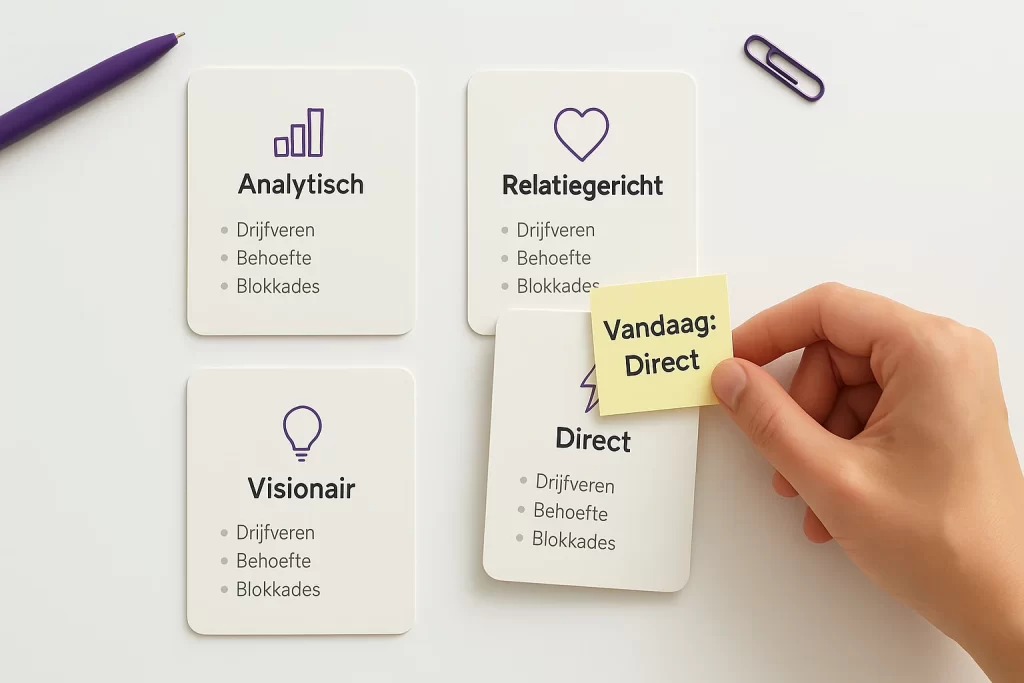
2. Learn to recognise who you’re dealing with
Not every customer thinks the same way. Some customers need clarity and structure, whilst others want to move quickly. Successful salespeople can switch between styles and customer types, enabling them to connect in any situation and close more deals
It starts with recognition: who is sitting opposite you? What drives this person? What do they value and what are their needs? What is holding them back? Our competency-based training helps you learn to read that behaviour and respond to it effectively.
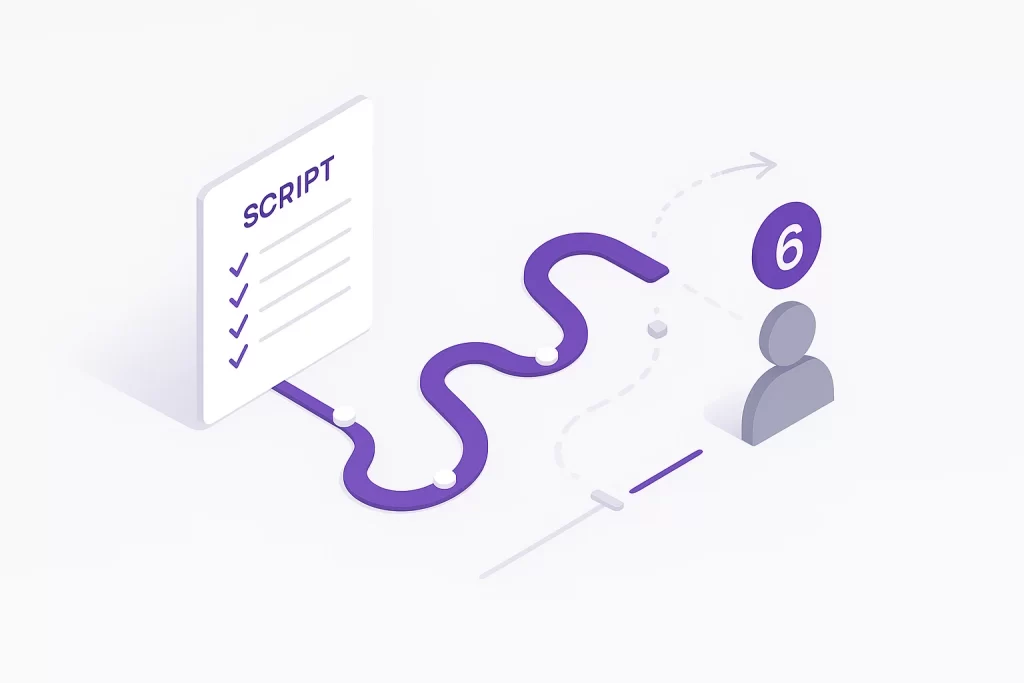
3. Dare to let go of your script
Many salespeople cling to scripts or step-by-step plans. That makes sense, because it feels safe. But in practice, customers often lose interest if things feel ‘too smooth’ or ‘too rehearsed’, or if their needs aren’t being met.
What you need is flexibility. Knowing where you want to go in a conversation, but also feeling the freedom to deviate if the situation calls for it. You can only learn that by practising with unpredictable situations. For example, with an AI customer who doesn’t react by the book.
4. Practise the conversations that really matter
Do you want to get better at handling objections, upselling or closing a deal? Then that’s exactly what you need to practise. Not just ‘sales conversations’ in general, but the moments that make a difference in your day-to-day work.
At PractAIce, you choose or create scenarios that suit your role and your customers. Such as explaining a price increase to a regular customer, or convincing a prospect who has already said three times: “I need to think about it a bit more.” You practise with an AI that responds, listens, and challenges you to do better.
5. Build in a routine
A single training session won’t change you. It’s the repetition that makes the difference. The salespeople who grow the fastest are those who practise consistently. Weekly. Briefly. Focused.
With us, you often see people suddenly practising consistently, simply because it’s easy to fit in. No travel time. No colleagues listening in. Just five to ten minutes of real practice, whenever suits you.
6. Practise your words, because they make all the difference
Sales is all about trust, so what do you say, how do you say it, and what do you leave unsaid? Which words do you choose? When should you use the power of silence or ask questions to clarify buying signals? Communicating persuasively and developing commercial skills are complex for many, partly because every customer is different.
That’s why, in our soft skills training, you can practise commercial skills such as listening, probing and persuading with different customer types. You can set the customer types yourself so that you get a highly realistic scenario that truly reflects real-life situations.
6. Train your words – because they make all the difference
In sales, it’s all about what you say and how you say it. Which words do you choose? How do you phrase your question? Do you get to the point, or do you ramble on for too long? With PractAIce, you practise exactly that: the language that persuades, the timing that works, and the phrasing that moves a customer forward. Because the right words open doors.
7. Ask for feedback you can understand
“Well done” or “you were a bit unclear” won’t get you anywhere. You only grow when you receive clear feedback on specific behaviour. That’s why at PractAIce you always receive feedback based on your choices during the conversation. Using quotes from your own conversation, we show you what went well, what could have been better, and how you could have phrased it differently. These are practical examples you can apply straight away.
And that makes it very clear: What did you do well and why? Where did you miss an opportunity and how can you avoid that next time? And what can you do differently next time to maximise the impact?
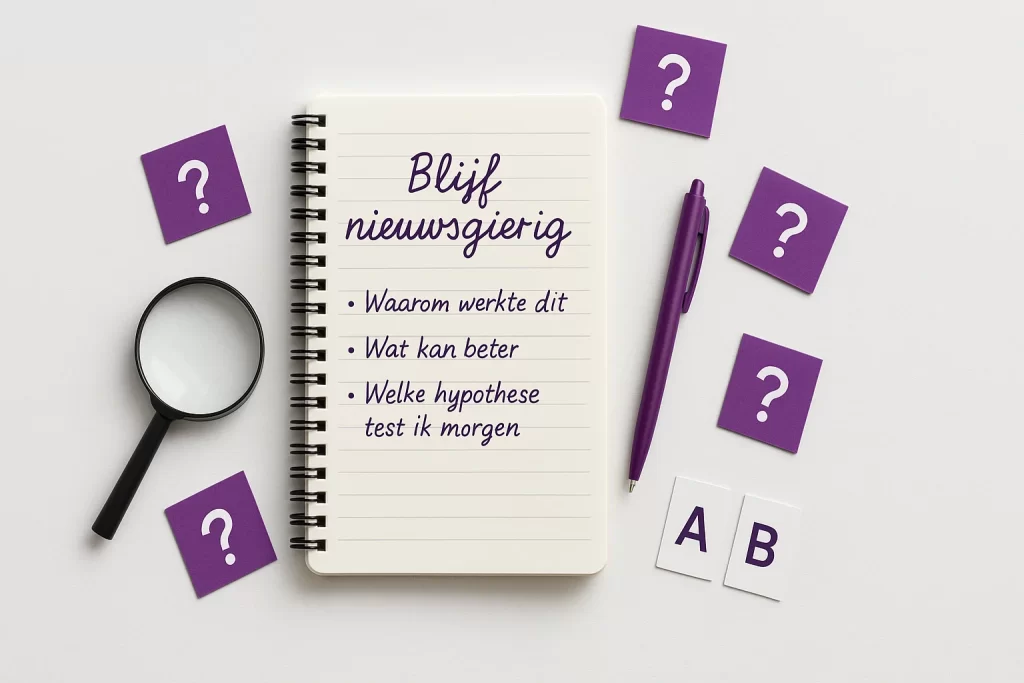
8. Stay curious
The best salespeople we know are curious. Not just about the customer, but about themselves too. They want to understand why something works, or why it doesn’t. They experiment. They ask questions. They dare to say: “This is new to me, but I want to learn it.”
At PractAIce, we foster that same mindset. Because you can practise in a safe environment, you build confidence. That makes learning more enjoyable, especially when you notice in practice that your conversations are improving and that you’re closing more deals as a result.
Frequently asked questions about improving your sales skills
Is this for beginners or advanced learners?
Both. Our tools and training courses scale with you. Novice salespeople learn the basics faster. Experienced professionals refine their approach and sharpen their instincts.
How do I know which steps to take?
With our conversation designer, you determine the steps yourself. You create your own role-play, choose the competencies and learning objectives that suit you, and put together a persona. In your personal dashboard, the AI coach then provides guidance, so you can see exactly which skills you can develop further.
Can I combine this with coaching or classroom training?
Absolutely. Our AI training courses are actually ideal as a supplement. They provide routine, practical experience and measurable results alongside other learning methods. We don’t offer classroom-based training ourselves, but we work with partners who do. This means you can combine both effectively.
Can I also combine this with coaching or classroom training?
Absolutely. Our AI training courses are ideal as a complement. They provide routine, practical experience and measurable results. We do not offer classroom-based training ourselves, but we work with partners who do. This allows you to combine both effectively.
Is this suitable for teams or just for individuals?
Both. Teams gain insight into shared learning objectives, whilst individuals train at their own level and work on their individual learning objectives. The platform is scalable and flexible.
How soon will I see results?
Often within a few weeks. Because you apply what you learn straight away, you’ll quickly see the effect in real conversations and in your personal dashboard, which provides a clear overview of your progress.
Ready to take the next steps?
Improving your sales skills starts with you. With practising. Observing. Adjusting. And trying again. Not just by reading or listening, but by doing. Want to find out how you can go about it? Book a demo and see for yourself how our AI training courses can accelerate your development. Or get in touch straight away for a no-obligation introductory meeting.